Confessions of a Reluctant Catholic

Derf

Well-known member
We only have to love them as much as we love ourselves.
You are missing some scripture. Jesus also said to do good to those who hurt you, which is how you love even your enemies. He didn't require us to do good to ourselves first (it was assumed).
 

Idolater

Popetard
We were asked to deny ourselves, take up our cross. DUTY

$$ Mt 11:28
Come unto me, all [ye] that labour and are heavy laden, and I will give you rest.
$$ Mt 11:29
Take my yoke upon you, and learn of me; for I am meek and lowly in heart: and ye shall find rest unto your souls.
$$ Mt 11:30
For my yoke [is] easy, and my burden is light.

"Yoke" here means duty.
 

Derf

Well-known member
We were asked to deny ourselves, take up our cross. DUTY
Since we're supposed to deny ourselves, it seems like it assumes we normally love ourselves. Duty means doing something even when we're uncomfortable (or in danger) doing it. discomfort in denying ourselves equates to loving ourselves normally. But even still, we are told that we save ourselves by denying ourselves. So a logical response of someone who loves himself will be to deny himself in order to save himself.
 

Idolater

Popetard
So I should expect the same for my neighbor.

You can objectively size up anyone you want. But you don't know anyone's heart. Also the diabolic << exist >>.

You old fool. I don't mean it in a bad way. But you're an old man, and you're foolish. Not wise.
 

Derf

Well-known member
So I should expect the same for my neighbor.
If you require love to enemies to be requited before you offer it, and your enemies oblige you, they are morally superior to you, a Christian. Yet as little Christs, we should be morally superior. Just like Jesus forgave His tormentors during their torments of Him.
 

Nick M

Fully Semi-Automatic
LIFETIME MEMBER
Hall of Fame
Every Mass you have the opportunity to partake of His nature.
3 Or do you not know that as many of us as were baptized into Christ Jesus were baptized into His death?

20 I have been crucified with Christ; it is no longer I who live, but Christ lives in me; and the life which I now live in the flesh I live by faith in the Son of God, who loved me and gave Himself for me.


So we are partaking of ourselves? Interesting.

edit: Why doesn't Paul talk about the symbolic passover that represents his death and resurrection on our behalf more often? He rebukes people in Corinth over it. And that is about it. This isn't rhetorical or snarky like above.
 
Last edited:

Idolater

Popetard
3 Or do you not know that as many of us as were baptized into Christ Jesus were baptized into His death?

20 I have been crucified with Christ; it is no longer I who live, but Christ lives in me; and the life which I now live in the flesh I live by faith in the Son of God, who loved me and gave Himself for me.


So we are partaking of ourselves? Interesting.


edit: Why doesn't Paul talk about the symbolic passover that represents his death and resurrection on our behalf more often? He rebukes people in Corinth over it. And that is about it. This isn't rhetorical or snarky like above.

I'll take your word for it.

Why doesn't Paul talk about the Eucharist more often? idk. I can only guess. Part of Catholicism is that Catholicism is presupposed in the New Testament, so we believe the Philippians, Colossians, Galatians, Corinthians, and Romans (ecclesial communions) were all celebrating the Eucharist all along and that the institution of the Eucharist was integral and essential to the establishment of a new church community. So the Eucharist was happening whether or not Paul wrote about it, no matter how frequently or rarely he mentioned it. We don't know when the Gospels were written exactly, we know the Gospel of Luke is associated with Paul because when Paul quotes the Lord in 1st Corinthians 11, he uses Luke's phrasing rather than Matthew or Mark's, plus we know Paul and Luke were close.
 

Derf

Well-known member
I'll take your word for it.

Why doesn't Paul talk about the Eucharist more often? idk. I can only guess. Part of Catholicism is that Catholicism is presupposed in the New Testament, so we believe the Philippians, Colossians, Galatians, Corinthians, and Romans (ecclesial communions) were all celebrating the Eucharist all along and that the institution of the Eucharist was integral and essential to the establishment of a new church community. So the Eucharist was happening whether or not Paul wrote about it, no matter how frequently or rarely he mentioned it. We don't know when the Gospels were written exactly, we know the Gospel of Luke is associated with Paul because when Paul quotes the Lord in 1st Corinthians 11, he uses Luke's phrasing rather than Matthew or Mark's, plus we know Paul and Luke were close.
Plus, the churches were in the habit of passing along the letters they received directly to those who had not seen them yet.
 

Nick M

Fully Semi-Automatic
LIFETIME MEMBER
Hall of Fame
Part of Catholicism is that Catholicism is presupposed in the New Testament
Presupposing is the problem. I come not but for the lost sheep of the house of Israel.
were all celebrating the Eucharist all along and that the institution of the Eucharist
There is no institution of symbolism. He stated the symbolism of the Passover to them, while hiding the meaning from them.
So the Eucharist was happening whether or not Paul wrote about it, no matter how frequently or rarely he mentioned it
Read what Paul said again about the Passover during the dispensation of grace. 1 Corinthians 11, without presupposing anything from false teachers in the third century where Paul said let them go to hell.

20 Therefore when you come together in one place, it is not to eat the Lord’s Supper.
 

VladtheDestroyer

Well-known member
Thinking today, about the past years in which I've been a reluctant Catholic. About how maybe "reluctant Catholic" was a good enough way to describe it, and then wouldn't you know, it's already out there, findable in a search, written about in a way that comfortably fits and better describes being a reluctant Catholic than what I could've done. So here she is, Alice McDermott. It's very long, so here's a little bit, but it's enough.

Also: This is for anyone who wants to understand how a lot of Catholics believe. Who doesn't understand why we do. So I'm not gonna spend time arguing Sola Scriptura. This is for the curious, it's not for the haters.

Confessions of a Reluctant Catholic​


... And I, after years of semi-indifference, occasional rejection, political objection, and unshakable associations (no other cure for a sleepless night than a rosary counted off on your fingers, no better solace for unnamed sorrows than a candle lit in an empty church), find myself at middle age a practicing Catholic. A reluctant, resigned, occasionally exasperated but nevertheless practicing Catholic with no thought, or hope, of ever being otherwise.​
​
I must confess (it’s a genetic thing, no doubt) that it occurs to me that it doesn’t bode well for our church at this millennium to have the likes of me as any kind of standard-bearer, and I offer this account of my own religious history only because it strikes me that it is similar to the religious history of many of us now middle-agers born into the Catholic faith. I offer you my own religious evolution not because it illustrates a triumph of faith but because it provides, perhaps, a place from which to talk about what brings us back, what leads us middle-aged born Catholics finally to choose the faith we were given from the very first moment of our lives. To a church we have, at various times in our lives, seen as flawed, irrelevant, outdated, impossible, and impossible to leave behind. . . .​
​
Catholicism, I began to see, was also mine, inextricably mine, the fabric of my life and my thoughts. It was the native language of my spirit, the way in which I had from the beginning thought about faith. And while I could acknowledge that there were indeed other languages for faith and that it may well be that those languages were more effective, less burdened by nonessentials, perhaps even superior to the language the Catholic church had provided me, I would have to live another life entirely in order to know them and to feel them as deeply or as inevitably as I knew and felt my Catholic faith. Resignation and delight: I am a Catholic after all. My only obligation, my profound obligation, is to make the best of it. . . . .​
​
It is not always easy to love the church, but then again, in my experience, it is not always easy to love anyone.​
​

Sounds pretty retarded.
 

annabenedetti

like marbles on glass

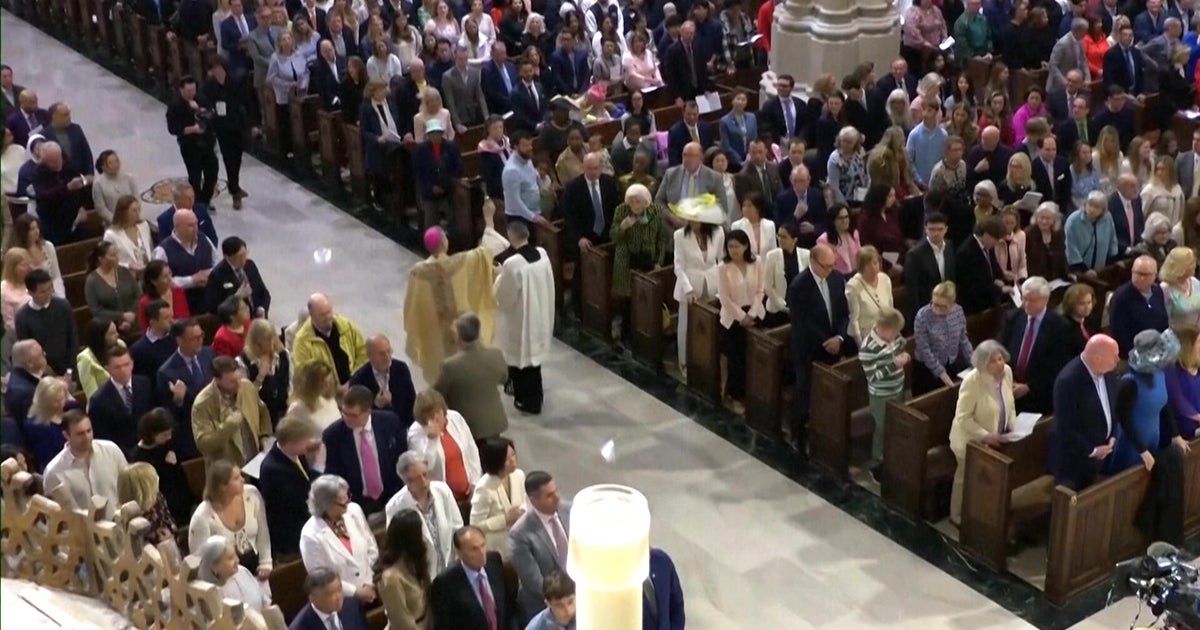
This past Easter, some archdioceses recorded their highest number of new Catholics in two decades.​
​
"The number of those joining the church this year is a record for the archdiocese, which is a wonderful thing," said Cardinal Robert McElroy of Washington, D.C., who noted that some 1,800 new Catholics were welcomed at this year's ceremony at the National Shrine of the Immaculate Conception. "We're seeing this across the country."​

My parish church is packed every Sunday. And it's a very large church.
 

VladtheDestroyer

Well-known member

This past Easter, some archdioceses recorded their highest number of new Catholics in two decades.​
​
"The number of those joining the church this year is a record for the archdiocese, which is a wonderful thing," said Cardinal Robert McElroy of Washington, D.C., who noted that some 1,800 new Catholics were welcomed at this year's ceremony at the National Shrine of the Immaculate Conception. "We're seeing this across the country."​

My parish church is packed every Sunday. And it's a very large church.

They will be losing a lot more than they say they've gained, once the USA finishes deporting 6 million of them.


Derf

Well-known member

This past Easter, some archdioceses recorded their highest number of new Catholics in two decades.​
​
"The number of those joining the church this year is a record for the archdiocese, which is a wonderful thing," said Cardinal Robert McElroy of Washington, D.C., who noted that some 1,800 new Catholics were welcomed at this year's ceremony at the National Shrine of the Immaculate Conception. "We're seeing this across the country."​

My parish church is packed every Sunday. And it's a very large church.
There's a national Catholic shrine to an unbiblical event that is antithetical to Christ's atoning work? That's weird.
 

annabenedetti

like marbles on glass
I came across this website Word&Way when I followed a link to their article about wellness bros and the vilification of seed oils. Not the subject of this thread, exactly, except it does tie wellness and religious purity together in a way that wouldn't reflect Catholic teaching. I'd read it because I know someone in real life who has a co-worker who could be described as a wellness bro and their stories about the coworker are both entertaining and disturbing, and I hadn't had a name for it before, and now I do.

Anyway. The following is an excellent repudiation of using AI to do your thinking for you, whether or not you (and your AI-using cohorts) insist they're your ideas. @Idolater yes, this is for you. I might've told you that in your thread if you'd been able to resist your "dog that didn't bark" but once you did that, I lost what little interest I had in refuting your mischaracterizations. It is admirable that you added your disclaimer that you'd had AI assistance, and I do appreciate that. But for the future: when a dog doesn't bark, you have to rule out the other reasons why it might not've, or the trope is a disservice to Sir Arthur.


Here's an excerpt:

Editor’s note: This piece is the second entry in a series on religion and AI. You can find the first installment here.


I am teaching a class this fall called “Religion and Artificial Intelligence,” and I already know what my students are going to do. I am going to assign them Pope Leo XIV’s new encyclical, Magnifica Humanitas, and some meaningful number of them are going to paste the link into a chatbot and read what it tells them the document says. I wanted to see what they would see, so I copied and pasted the link into Claude myself.​
​
What they will see is pretty good. In under a minute, I had a clean, organized summary under tidy headings. Babel. The technocratic paradigm. Disarming AI. The dignity of work. The scarred bodies of the men who mine the rare earths. Migrants as the litmus test of justice. In terms of content, it was accurate, fast, and on the strength of it a student could hold up her end of a seminar discussion without ever opening the document.​
​
And that is the problem. So on the first day of classes, I want to tell my students a couple of things.​
​
First, a summary of an encyclical is not a shorter encyclical. It is a different kind of thing wearing the document’s clothes. Encyclicals are not built like articles. They do not have a thesis you can lift out and carry off. They argue by accumulation, the way the tradition itself argues, which is why Pope Leo spends his entire first chapter walking through a hundred and thirty-five years of Catholic social teaching before he says a single word about computers. He signed the encyclical on May 15, to the day the anniversary of Leo XIII’s Rerum Novarum, the 1891 letter on labor and capital written into the teeth of the first industrial revolution.​
​
A chatbot reads that first chapter as preamble and trims it. But it is not preamble — it is the argument. The claim being made is that artificial intelligence is not a new subject requiring new principles, but an old question arriving in new clothes, and the only way to make that claim is to take the long walk and let the reader feel how old the road is. . . .​

Here is what I am not going to let the chatbot do for my students. I am not going to let it hand them the conclusion that human making has consequences while sparing them the work of reading the pages in which a man works out, slowly and in public, what those consequences are and what we owe each other because of them. The conclusion is free. Anyone can have it in under a minute. The reckoning is not free. It costs you the effort of reading.​
​
There is a passage in the fourth chapter, and no summary I have seen contains it, where Leo worries about schools. His fear is not that students will cheat. It is that machines which appear to think perfectly will make human thinking look useless, and that the desire to ask a question will quietly go out in the young. He wants schools to be places where people learn to seek and love the truth. That sentiment does not survive translation into a bullet point.​
​
I read that paragraph and understood my syllabus differently. The point of my class is not that my students will know what the encyclical says. A machine can tell them that tomorrow, for free. The point is that they will have done the thing the machine cannot do, which is to sit with a long and difficult argument, in time, in sequence, and come out the other side changed by it, or at least equipped to argue back.​
​
The machine will offer to read it for you. That is the whole trouble with the machine. Read it yourself.​
​
Rev. Kristel Clayville, Ph.D., is ordained in the Christian Church (Disciples of Christ) and writes and teaches at the intersection of religion, technology, and ethics.​
​
​

@Idolater: Your own words, coming from your own thought processes, formed uniquely by you and filtered through your lifetime of nature and nurture, will always be authentically you. Whether they're brilliant, perceptive, appalling, flawed. Once you ask AI to 'refine' or 'organize' your thoughts, you will have made AI your coauthor, and what you write is no longer authentically, humanly you.

I just don't want to engage with that, knowingly.

I know I already have, unknowingly, but it won't be willingly.

 
Last edited:
Top