Well I believe that God is all knowing but we have to define what the Word, to know is.
Sure.
God is capable of knowing anything that is knowable, but He is free to choose what He knows.
The question is whether future free choices are presently knowable facts in the first place.
And we have to recognize that in the beginning God created the heavens and the earth.
Agreed.
As other scholars have pointed out space time and matter first came into existence Because God created those things.
Matter, yes.
Space requires a bit more care in defining what we're talking about. The physical universe and its spatial dimensions had a beginning, but space itself is not some independently existing material substance.
Time, however, is another matter entirely.
Time is not a substance or an independently existing thing. It describes the succession of events, the distinction between before and after.
And time cannot have been created.
Why?
Because creation is an act. Something that did not previously exist comes into existence. There is a before and an after.
But before and after are temporal concepts!
You're claiming that time came into existence through an act that necessarily presupposes its own existence.
In other words, time would have to exist in order for time to be created.
That's circular reasoning.
Even your description of God's alleged creation of time requires temporal language.
Furthermore, Genesis 1:1 says that God created the heavens and the earth. It says nothing about God creating time.
Therefore God is greater than space time and matter. He does not live within time he operates outside of time. Time is creation that God did. Therefore he knows the past the present the future all the time.
You've simply repeated your premise without establishing it.
If God exists outside of time, how does He think, act, create, or respond to anything?
Each of those activities involves succession.
God acts, and then something happens as a result of that action. God speaks, and then His creation responds. God makes a decision, and then carries it out.
These are temporal relationships.
And even if I granted your premise that God exists outside of time, you still haven't demonstrated that the future is exhaustively settled.
You're assuming the very thing we're discussing!

kgov.com
There are two Greek words that are useful for understanding knowing. One is ginosko and the other is oida. ginosko is to know by experience. oida is to be aware of.
The distinction isn't quite that rigid.
Both words have overlapping meanings, including knowing, understanding, and perceiving.
In fact, Jesus uses both words in John 8:55 when discussing knowledge of the Father.
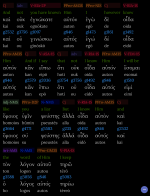
But let's grant your distinction for the sake of argument.
God is not the cause of evil he is not the source of evil therefore he cannot experience being the cause of evil. He is however aware of evil. So God being all knowing He certainly is aware of everything but He has not personally been involved with everything God is good always therefore God personally involved with being the source of all that is good but he is not the source of evil so he's not personally involved with being the source of evil.
Okay, but what does any of that have to do with the issue?
Nobody is arguing that God must personally commit evil in order to know about it.
Being aware of something and experiencing it firsthand are not mutually exclusive. Neither does experiencing something make you its cause.
Consider Genesis 18:20-21.
God had received information about the wickedness of Sodom and Gomorrah, yet He declared that He would go down and see for Himself.
Was God the cause of their wickedness?
Of course not!
Did He already possess knowledge of their wickedness?
Obviously!
Yet He chose to investigate further.
And the Lord said, “Because the outcry against Sodom and Gomorrah is great, and because their sin is very grave, I will go down now and see whether they have done altogether according to the outcry against it that has come to Me; and if not, I will know.”

www.biblegateway.com
As I've already explained in this thread, God knows what He chooses to know out of what is knowable.
He has the capacity to know anything that can be known, but that doesn't mean He must exercise that capacity exhaustively at every moment.
He's a living, personal God who is free to choose what He wants to know, when He wants to know it, and whether He wants to experience something firsthand.
Your distinction between
ginōskō and
oida doesn't establish otherwise.
Nor does it establish exhaustive foreknowledge.
You've explained how God can know about evil without being its author. Fine. We agree!
But you haven't demonstrated that every future free decision is already a settled fact available to be known.
And that's the actual issue here.
How can God know a future free decision as an established fact when that decision has not yet been made?