Different Stuff

Nick M

Fully Semi-Automatic
LIFETIME MEMBER
Hall of Fame
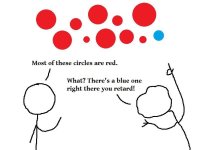
I pose a question, because I see one of 2 choices. When staring truth in the face, is the person stupid or evil when they deny it? That is a real question, and the person, here and everywhere really, explodes. Rightly so I suppose, making them stupid. Right here recently on the concept of everything is fully determined ahead of time, or it isn't. When you let God speak for himself in the Bible, people get mad. Not just here, all over the place.

Which seems hard to believe. Is it really just pride in not wanting to be shown they were wrong? I love being shown something I thought was wrong, so I don't have to be wrong any more.
 

JudgeRightly

裁判官が正しく判断する
Staff member
Administrator
Super Moderator
Gold Subscriber
I pose a question, because I see one of 2 choices. When staring truth in the face, is the person stupid or evil when they deny it? That is a real question, and the person, here and everywhere really, explodes. Rightly so I suppose, making them stupid. Right here recently on the concept of everything is fully determined ahead of time, or it isn't. When you let God speak for himself in the Bible, people get mad. Not just here, all over the place.

Which seems hard to believe. Is it really just pride in not wanting to be shown they were wrong? I love being shown something I thought was wrong, so I don't have to be wrong any more.

As @Clete said, it's called entrenchment.

There is actually a term for this. It's called "entrenchment".

People make decisions based on a perceived cost/benefit analysis. There is no actual analysis done in the methodical sense of the word, but merely on an intuitive basis. Someone perceives an idea and a lightning calculation is done that instantly tells them (rightly or wrongly) that the cost of accepting such an idea is far too high. The more time, energy, money and effort has been invested into their current paradigm the harder it is to ever break them out of it. It simply costs too much. Imagine a pastor of a church, or anyone with a long standing ministry having to alter large swaths of the doctrine that they not only have spent years learning and teaching to others but that they also make their living from. Every friend they have probably exists within the orbit of that ministry. You couldn't hardly find anyone more deeply entrenched than that.

For this reason, paradigm shifts must be approached slowly, methodically and with extreme care. Each step that is taken on the path leading to the new paradigm has to be accepted fully all along the way and when the destination is arrived at, the whole path taken to get there has to be visible in the mind's eye such that it seems that no other path could have been taken. They have to feel like they arrived there under their own power and when the light bulb moment happens, they have to feel like they would have flipped the switch themselves had they known the switch existed. Otherwise, the new paradigm will definitely be rejected. It may be rejected anyway, but if there are plausible excuses to do so, the likelihood of the rejection is increased exponentially, especially for those who are deeply invested into that which they have to walk away from.
 

Derf

Well-known member
There seems to be a graded scale between stupidity and evil. I dont remember the exact verse but the prophet Samuel told Saul "Your stubbornness has become equal to idolatry!"
1 Samuel 15:23 KJV — For rebellion is as the sin of witchcraft, and stubbornness is as iniquity and idolatry. Because thou hast rejected the word of the LORD, he hath also rejected thee from being king.
 

Derf

Well-known member
As @Clete said, it's called entrenchment.
How would someone actually cause entrenchment in someone else? I ask because our church is going through Exodus and talking about God hardening Pharaoh's heart. I don't think it's necessarily difficult, but I'm not sure of all of the technique. For instance, I think Pharaoh had magicians who could make a staff appear to turn into a snake, and could cause water to turn into blood and frogs to appear, so He picked those signs on purpose to cause Pharaoh to harden his heart.
 

JudgeRightly

裁判官が正しく判断する
Staff member
Administrator
Super Moderator
Gold Subscriber
How would someone actually cause entrenchment in someone else? I ask because our church is going through Exodus and talking about God hardening Pharaoh's heart. I don't think it's necessarily difficult, but I'm not sure of all of the technique. For instance, I think Pharaoh had magicians who could make a staff appear to turn into a snake, and could cause water to turn into blood and frogs to appear, so He picked those signs on purpose to cause Pharaoh to harden his heart.

Bob Enyart gave this example (specifically with regards to how miracles produce unbelief) or close to it (I don't remember if it was two of his boys or just an analogy, so I'll just reproduce it as best I can):

Two brothers are playing, and the older one says let's go inside and have the leftover pasta that's in the fridge. The other says, no, there isn't any pasta leftover, it had already been eaten. So they get into an argument about it, and finally the older says fine, let's just go inside and look in the fridge. So they head inside and sure enough, there's leftover pasta sitting there in the fridge.

Do you think that the younger brother is happy about being proven wrong?
 
Top