The verse makes no mention of only physical creation being mentioned and rather includes the invisible creation by mentioning that man was created lower than Angels.
Rather 'the work of His hands.' I can see angels in that, but we also have to draw, I believe in this instance, from Genesis because it is when man was 'put in charge.' Genesis 1:26 You'll observe with me, that everything there, is earth and angels aren't mentioned. While you may have a good argument concerning angels, at least some time in the future, and while I know you are working on a train of thought between 'all' from one to the other passage, I don't believe it helps much with your case when specifically the scripture itself gives one without any restriction, and the other gives a qualified 'all.' So in the first, even if you proved something from Hebrews as limiting, is nonextistent in John. You want to be as Biblical as I am, so I know you have to agree on this particular. While I don't generally go down rabbit holes, specifically because can anticipate where the questions are headed, and why they are being asked, I can entertain some of it in courtesy, but the gist is that we cannot rationalize our way. Scripture itself qualifies the extent of all in both passages. Further? Eisegesis is going on when we scripture hop. Going to Genesis isn't best either, but it does help a little and is much more directly related to the scope of man's dominion.
Also, I'm not suggesting whether the verse does or doesn't imply the Angels and God were subject to Man, I'm asking YOU if the "all things" is inclusive of God and the angels.
As I said, I can anticipate, but your argument breaks down on this: The first goes so far as to literally say "AND without Him, nothing was made that was made." It literally explains the extent of 'all.' Then in Hebrew, 'all' is literally confined with 'work of His hands.' That IS the answer: "Scripture tells us clearly."
You've asked me questions relating to my question and given an illustration but nowhere do I see you expressing whether or not you you understand the "all things" to be including God or the Angels in the statement of excluding them.
I believe I've been clear: No. The text says 'all the work of His hands' alone. Regardless, I have clearly answered this question: the scripture itself 'all' is specificaly qualified as 'everything' and Hebrews is specifically not just 'any and all' but given with a narrow scope of understanding. So, if God tells you "No limit' in the first and then 'within this limit' in the second, you should listen to God. Your reasoning and trying to find a loophole to jump through isn't working.
Does the "all things" in Hebrews 2:8 include God and the angels or are you suggesting the they are not included in the "all things" based on the preceding context?
Correct. It isn't 'all things' BUT "all things under the works of His hands." The answer then, as badly as you want to say they are the same "all things," clearly, Scripturally, and clearly discussed by God very God, they are not. One says "all things" no qualifications. The second "all things" within a specific set of qualifications." Let me ask you a question back: Why DO YOU want the Lord Jesus Christ 'bound up' and 'limited' by what He can do? What is the point of diminishing the Creator? Why do it? To what Holy, Christ-honoring end?
to cause to know something; to cause to know how; to accustom to some action or attitude… See the full definition
www.merriam-webster.com
Now, with that out of the way, I can give you a few example of scripture that teach (when looking at the big picture) that God is triune:
Let's start by first pointing out Moses' use of the plural form of "God," while simultaneously using a singular verb, in the very first verse of the Bible.
In the beginning God (Elohim) created (bara - He created) the Heavens and the earth.
Genesis 1:1
Either that's a typo in the very first verse in the Bible that NO ONE has caught, even though it's literally the most studied verse in all of theology, OR it's a statement of the plurality of God (one Being, but a plurality of persons). We see this throughout scripture, where every time God is referred to as doing something, it is almost if not always the plural form of "God" accompanied by the singular form of a verb.
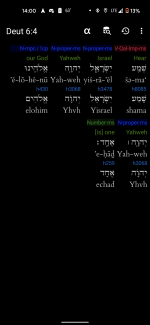
Next, we have Deuteronomy 6:4.
Hear, O Israel, the LORD [YHWH] our God (Elohim), the LORD [YHWH] is one [echad - one of unity, not of singularity].
Here we have YHWH defined as Elohim, and described as being one, not as a singular entity, but as a united entity. Note that the same word, echad, is used in Genesis 2 to describe how man and woman become "one flesh." They are still two individual persons, but they (all things being perfect) act as one united entity.
What about examples where God is described of in two locations simultaneously, as two distinct Entities (trying not to beg the question here, so I'm using Entities rather than Persons)?
Then the LORD [YHWH] rained brimstone and fire on Sodom and Gomorrah, from the LORD [YHWH] out of the heavens.
Perhaps a better way of putting it is that the LORD [YHWH] is localized to two specific locations, the LORD in the heavens, and the LORD on earth, probably somewhere just outside of Sodom and Gomorrah, likely in the appearance of a man, as described in Genesis 18.
But that's all Old Testament stuff. How about stuff from the New Testament?
First, as I've pointed out before (and as the article https://kgov.com/deity explains), over 400 times in the Old Testament, the chosen prophets of God use the phrase "Thus says the LORD," when they are about to relay a message to Israel that comes directly from God. Yet, in the New Testament, especially in the Gospels where Jesus speaks the most, we do not find a single instance of "Thus says the LORD." Instead, it is replaced with Jesus saying, "I say unto you."
In addition to Him using that phrase, which in and of itself, if He is not God, is blasphemy, as the Bible describes God as speaking by His Son, because Jesus, in uttering such a phrase, is not saying "what I'm about to say is straight from God," but rather, "I am God, and here is what I say," Jesus also makes several other statements that things ONLY God has the right to say, focusing His message, not on God, as every prophet in the OT did, but on Himself, such as:
Pray and act "in My name" 18x Mt. 7:22; 18:5; 18:20; [24:5]; Mk. 9:37, 39, 41; [13:6]; Lk. 9:48; [21:8]; 24:47; Jn. 14:13-14; 15:16; 16:23-24, 26; Acts 9:15
"the Holy Spirit" comes "in My name" Jn. 14:26
"for My name's sake" leave family and property Mt. 19:29; or even be killed 5x Mt. 24:9; [Lk. 21:12, 17;] Jn. 15:21; Acts 9:16
Believe in the "name of the… Son" and "in the Son" 3x Jn. 3:18, 36; 9:35 and "in Him " 4x Jn. 3:18; 6:29, 40; 8:31
[*]"believe in Me" 14x Mt. 18:6; Mk. 9:42; Jn. 3:15-16, 18; 6:35, 47; 7:38; 11:25, 26; 12:44, 46; 14:1, 12; 16:8; 17:20
[*]You "are sanctified by faith in Me" Acts 26:18
[*]Live "in Me" Jn. 11:26
"come after Me" Mk. 8:34; Lk. 14:27
[*]Abide "in Me" Jn. 15:2, 4:5, 7 "abide in Me" or else Jn. 15:6 "abide in My love" Jn. 15:9-10
[*]"where two or three are gathered" Jesus is "there in the midst of them" Mt. 18:20
[*]So too: "I [Jesus, will abide] in you" Jn. 15:4-5
[*]"know that I am He" Jn. 8:28 or "if you do not believe that I am He you will die in your sins" Jn. 8:24
[*]Do things "for My sake" Mt. 10:22, 39; even lose your life "for My sake" 4x Mt. 16:25; Mk. 8:35; 10:29; Lk. 6:22
[*]"I never knew you, depart from Me" Mt. 7:23
[*]"I am willing; be cleansed" Mt. 8:3; Mk.. 1:41
[*]"confess Me" Mt. 10:32; Lk. 12:8
[*]Do not deny "Me" 7x Mt. 10:33; 26:34; Mk. 14:30, 72; Lk. 12:9; 22:34; Jn. 13:38
[*]Do not be "ashamed of Me" Mk. 8:38; Lk. 9:26 nor "My words"
[*]"love Me" 5x Jn. 14:15, 21, 23-24, 28
[*]Do not reject "Me" Lk. 10:16; Jn. 12:48
[*]"He who is not with Me is against Me" Lk. 11:23
[*]Love Me "more than" your family members Mt. 10:37; [Lk. 14:26]
[*]"I… have loved you" Jn. 15:9, 12
[*]Be "worthy of Me" Mt. 10:37-38
[*]"Come to Me" 5x Mt. 11:28; Lk. 6:47; Jn. 5:40; 6:35; 7:37
[*]"I will give you rest" Mt. 11:28
[*]"For My yoke is easy and My burden is light" Mt. 11:30
[*]I am "greater than the temple" "than Jonah" "than Solomon" Mt. 12:6, 41-42
[*]I am "Lord even of the Sabbath" Mt. 12:8; Mk. 2:28; Lk. 6:5 [Lord of God's Ten Commandments]
[*]Thus He says keep "My commandments" 4x Jn. 14:15, 21; 15:10, 12
[*]"You are My friends if you do whatever I command you" Jn. 15:14
[*]"keep My word" Jn. 14:23-24
[*]"He who is not with Me is against Me" Mt. 12:30
[*]The angels are "His angels" Mt. 13:41; 16:27 and He commands "His angels" Mt. 24:31; Mk. 13:27
[*]The kingdom is "His kingdom" Mt. 13:41 and He calls it "My kingdom" Lk. 22:30
[*]Jesus called it "My church" Mt. 16:18 and believers are "My sheep" Jn. 10:14, 27 and they are "His elect" Mt. 24:31; Mk. 13:27
[*]Paul is a "vessel of Mine to bear My name" Acts 9:15
[*]"all Mine are Yours, and Yours are Mine" Jn. 17:10
[*]"My peace I give" Jn. 14:27 "in Me you may have peace" Jn. 16:33
[*]"My joy" should fill you Jn. 15:11
[*]"Who do men say that I am?" Mt. 16:13; Mk. 8:27
[*]"who do you say that I am?" Mt. 16:15
[*]Receive "Me" Mt. 18:5; Mk. 9:37; Lk. 9:48
[*]Heaven and earth will pass away but "My words" will never Mt. [5:18] 24:35; Mk. 13:31; Lk. 21:33
[*]Tell others about Jesus Mk. 5:19
[*]"you belong to Christ" Mk. 9:41
[*]Hear "My sayings" and do them Lk. 6:47
[*]Jesus has "His own glory" Lk. 9:26; [Jn. 2:11; 16:14] The Son is "glorified" 8x Jn. 11:4; 12:23; 13:31-32; [17:1, 5, 10 24]
[*]"He who hears you hears Me" Lk. 10:16
[*]Jesus expects praise, from stones if necessary Lk. 19:37-40
[*]Return "to Me" Lk. 22:32
[*]Be "My disciple" Lk. 14:27; Jn. 8:31; 15:8 Forsake all to "be My disciple" Lk. 14:33 "you are My disciples" Jn. 13:35
[*]"I shall send… the [Holy] Spirit" Jn. 15:26; 16:7
[*]The Holy Spirit "will testify of Me" Jn. 15:26
[*]We read in John 5 and Luke 24 that "the Scriptures… testify of Me" Jn. 5:39; [Lk. 24:44]
[*]"You [Apostles] also will bear witness [of Me] because you have been with Me" Jn. 15:27
[*]Paul gives "testimony concerning Me" Acts 22:18; 23:11
[*]"the Son gives life to whom He will" Jn. 5:21
[*]"seek Me" Jn. 6:26
[*]Serve "Me" Jn. 12:26
[*]"all should honor the Son just as they honor the Father" Jn. 5:23
[*]"I am the bread of life," "of heaven," "of God" Jn. 6: 32-33, 35, 41, [48,] 51
[*]Just seeing Christ is reason enough to believe in Him Jn. 6:36 [56]
[*]Drink "My blood" and eat "My flesh" Jn. 6:53-54, 56
[*]"I will raise him up at the last day" Jn. 6:40 for He is the resurrection
[*]"The world… hates Me" Jn. 7:7
[*]"I am the light of the world" Jn. 8:12; 9:5; 12:46
[*]"I bear witness of Myself" Jn. 8:13-14, 18
[*]"know… Jesus Christ" for "eternal life" Jn. 17:3; [8:19; 10:10, 14]
[*]"the Son makes you free" Jn. 8:36
[*]"Abraham rejoiced to see My day" Jn. 8:56;
[*]"Before Abraham was, I AM" Jn. 8:58
[*]Of believers, Christ said, "I know them" Jn. 10:27
[*]"I give them eternal life" Jn. 10:28
[*]"I am the resurrection and the life" Jn. 11:25
[*]I "will draw all peoples to Myself" Jn. 12:32
[*]"I will… receive you to Myself" Jn. 14:3
[*]Be "Mine" Jn. 14:24
[*]"I am the vine" Jn. 15:5
[*]"without Me you can do nothing" Jn. 15:5
[*]"You did not choose Me, but I chose you and appointed you" Jn. 15:16
[*]Those who oppress Christians are "persecuting Me" Acts 9:4-5; 22:7-8; 26:14-15
[*]"because they have not known… Me" Jn. 16:3
[*]The Spirit "will glorify Me, for He will take of what is Mine and declare it" Jn. 16:14
[*]"All things that the Father has are Mine" Jn. 16:15
[*]"the Father… loves you, because you have loved Me" Jn. 16:27
[*]"If I will that he remain" Jn. 21:22
[*]"I have overcome the world" Jn. 16:33
[*]"I am the way" Jn. 14:6
[*]"I am… the truth" Jn. 14:6
[*]"I am… the life" Jn. 14:6
[*]"I will… manifest Myself" Jn. 14:21
Hebrews also teaches us that Christ is God, John 1:1, 20:28; Hebrews 1:1-14.
And then we have the Holy Spirit being called God, Acts 5:3-4.
And of course, no one would deny that the Father is God, 1 Thessalonians 1:1
Shall I go on?
All of this and more, when you stand back and try to get the big picture, teaches that Jesus is God, and that God is triune.
So, three questions for you, NWL.
THREE QUESTIONS TO DETERMINE IF THE TRINITY IS BIBLICALLY TRUE OR FALSE. If any one of these questions can be answered 'no,' then the Trinity can be rejected as an unbiblical belief. But if all three can be answered 'yes,' then the concept of the Trinity can be accepted as true.
1. Does the Bible mention three distinct persons?
2. Does the Bible refer to each of these persons as God?
Yes I do. 1 Corinthians 6:3, but for now, Hebrew 2:7,9 says we are lower (and disqualified now in sin as Hebrews 2 continues).
Rather 'the work of His hands.' I can see angels in that, but we also have to draw, I believe in this instance, from Genesis because it is when man was 'put in charge.' Genesis 1:26 You'll observe with me, that everything there, is earth and angels aren't mentioned. While you may have a good argument concerning angels, at least some time in the future, and while I know you are working on a train of thought between 'all' from one to the other passage, I don't believe it helps much with your case when specifically the scripture itself gives one without any restriction, and the other gives a qualified 'all.' So in the first, even if you proved something from Hebrews as limiting, is nonextistent in John. You want to be as Biblical as I am, so I know you have to agree on this particular. While I don't generally go down rabbit holes, specifically because can anticipate where the questions are headed, and why they are being asked, I can entertain some of it in courtesy, but the gist is that we cannot rationalize our way. Scripture itself qualifies the extent of all in both passages. Further? Eisegesis is going on when we scripture hop. Going to Genesis isn't best either, but it does help a little and is much more directly related to the scope of man's dominion.
As I said, I can anticipate, but your argument breaks down on this: The first goes so far as to literally say "AND without Him, nothing was made that was made." It literally explains the extent of 'all.' Then in Hebrew, 'all' is literally confined with 'work of His hands.' That IS the answer: "Scripture tells us clearly."
I believe I've been clear: No. The text says 'all the work of His hands' alone. Regardless, I have clearly answered this question: the scripture itself 'all' is specificaly qualified as 'everything' and Hebrews is specifically not just 'any and all' but given with a narrow scope of understanding. So, if God tells you "No limit' in the first and then 'within this limit' in the second, you should listen to God. Your reasoning and trying to find a loophole to jump through isn't working.
Correct. It isn't 'all things' BUT "all things under the works of His hands." The answer then, as badly as you want to say they are the same "all things," clearly, Scripturally, and clearly discussed by God very God, they are not. One says "all things" no qualifications. The second "all things" within a specific set of qualifications." Let me ask you a question back: Why DO YOU want the Lord Jesus Christ 'bound up' and 'limited' by what He can do? What is the point of diminishing the Creator? Why do it? To what Holy, Christ-honoring end?
You've answered exactly how I wanted you to answer. If I wanted to use a verse that restricts the understanding of panta (all things) I would've used Col 1:18 that suggests Jesus is first in "all things" without much qualification. Instead, I used Hebrews 2:8 which uses strong definite language, similar to that of John 1:3, but to which the context limits the extent of what "all things" can be applied to.
John 1:3 states "Through him all things were made; without him nothing was made that has been made", the "all things" here is limited to the context and does not necessarily exclude Jesus. This is because the "all things" relates to physical creation, much like Hebrews 2:8, as you correctly deduced. John 1:1 states, "in the beginning was the Word, and the Word was with God"; the "beginning" in John 1:1 is a parallel and reference to the beginning in Gen 1:1, as most scholars agree.
Therefore, when John 1:3 states, "Through him all things were made; without him nothing was made that has been made", this must be understood in light of the preceding context, just as you correctly deduced was the case in Hebrews 2:8.
This all being taken into account, it demonstrates Jesus can be considered part of creation without it contradicting John 1:3 since the "all things" only relates to the creation of the "heavens and Earth" and the things therein and not all of creation outside the Genesis context.
To sum up, John 1:3 does not imply Jesus is not part of creation or that he is the originator of entirely everything, rather, it only expresses he participated in the creation of the heaven and earth, and that nothing that has been made on in heaven and earth has been made except through him.
Why DO YOU want the Lord Jesus Christ 'bound up' and 'limited' by what He can do? What is the point of diminishing the Creator? Why do it? To what Holy, Christ-honoring end?
I'm not, I'm merely trying to express what the scriptures say about him. I have applied no concepts to him or limited him in anyway which is not cearly expressed in scripture. What I'm not doing is allowing my personally beliefs to effect what the scriptures say.
The people who wrote the scriptures were trinitarians. They may have not gone by that name, but they understood that there was a plurality in the Godhead, while still believing in only one God, and the nature of God was further revealed in NT times, especially at points such as at Jesus' baptism by John, where God the Father, God the Son, and God the Holy Spirit were clearly made known, the Father by His voice, the Son in the Flesh, and the Holy Spirit taking the form of a dove.
So yes, trinitarians DID, in fact, give us the scriptures, just not how TG puts it.
First, as I've pointed out before (and as the article https://kgov.com/deity explains), over 400 times in the Old Testament, the chosen prophets of God use the phrase "Thus says the LORD," when they are about to relay a message to Israel that comes directly from God. Yet, in the New Testament, especially in the Gospels where Jesus speaks the most, we do not find a single instance of "Thus says the LORD." Instead, it is replaced with Jesus saying, "I say unto you."
You've answered exactly how I wanted you to answer. If I wanted to use a verse that restricts the understanding of panta (all things) I would've used Col 1:18 that suggests Jesus is first in "all things" without much qualification. Instead, I used Hebrews 2:8 which uses strong definite language, similar to that of John 1:3, but to which the context limits the extent of what "all things" can be applied to.
John 1:3 states "Through him all things were made; without him nothing was made that has been made", the "all things" here is limited to the context and does not necessarily exclude Jesus. This is because the "all things" relates to physical creation, much like Hebrews 2:8, as you correctly deduced. John 1:1 states, "in the beginning was the Word, and the Word was with God"; the "beginning" in John 1:1 is a parallel and reference to the beginning in Gen 1:1, as most scholars agree.
Therefore, when John 1:3 states, "Through him all things were made; without him nothing was made that has been made", this must be understood in light of the preceding context, just as you correctly deduced was the case in Hebrews 2:8.
This all being taken into account, it demonstrates Jesus can be considered part of creation without it contradicting John 1:3 since the "all things" only relates to the creation of the "heavens and Earth" and the things therein and not all of creation outside the Genesis context.
If you'll also recall, I said that it cannot be because John 1:3 Emphatically says these 3 things:
1) Through him all things were made
While you 'might' have been able to suggest a broader or limited sense with just this first part of the verse, note one thing from here: The Greek uses Auto "Him" so any misrepresented idea that the Word is not an actual person in John 1:1 must be rejected on the grounds of the language itself: "His."
2) without him nothing was made
The word for word is literally: Not one thing, literally. John says it, not me, or other trinitarians, but the one inspired by God, to accurately give truth: Not even remotely one thing (emphasis but very true to the meaning), it means literally that, so you have both the thought STRONGLY conveyed by John himself AND the word for word that makes impossible to try and put any limitation on it. Then:
3) that has been made
This is a double-emphasis. The above in translation and conveyance is already clear, but John doubled-down to completely erase any 'possibility' even of contentions. Grammar is so incredibly important. I'm VERY convinced if Unitarians took grammatical lessons, they couldn't possibly make an argument against John's scripture truth here. It is a) literal and b) clear, even if one doesn't quite grasp the logic. I absolutely empathize with anyone saying "What???" in John 1:1 when it says emphatically "was with" AND "was" God. Such is by all natural inclination and mathematical logic, not possible. I agree BUT it is exactly what John says SO I'm Triune as I understand scripture and cannot help but be, because it is exactly what John (God inspiring Him with His own thoughts and own book) says. I 'literally' cannot be anything else but what scripture demands that point. I simply and happily embrace the confusion of it.
Like you and Modalists, I truly believe there is One God, alone. Yet right in front of me, with no scruples whatsoever is: "Was with" God AND 'was God!' I could try and come to some conclusion BUT listen to what I just said: I could try to come to a conclusion. The problem? 1) me (as a fallible human, despite how intelligent I am, just got in God's way. I cannot possibly know His nature without the scriptures specifically because I am not Him, Not eternal, do not have the wherewithall, AND am a fallen being. I literally, as intelligent as I am, don't know unless He alone tells me (and He has). I don't WANT my-ology. I want His-ology. There is no point and definitely nothing good from me asserting anything.
If you can follow: A Trinitarian, unless he/she doesn't grasp something and is going beyond the text, will only give and insist, that what we say or know about God MUST NOT be derived from human intellect. While we grasp Him with our minds, going beyond the text to "Fill in the gaps" no matter how logical it might seem, is 1) not scripture at that point and 2) Is certainly open to criticism as wrong specifically because it is 'man-made' at that point. For us: John 1:1 says two things literally: 1) was with God AND 2) was God. We simply, with NO other thought, accept what is told without reservations. It is 'just scripture' and 'scripture alone without man gunking it up' at that point.
To sum up, John 1:3 does not imply Jesus is not part of creation or that he is the originator of entirely everything, rather, it only expresses he participated in the creation of the heaven and earth, and that nothing that has been made on in heaven and earth has been made except through him.
Incorrect. That is YOUR (a man, however intelligent you imagine you are) statement. John actually doubled-down. It really leaves no such option (again if you conceive correctly the nature of grammar). The Apostle completely eliminated that conjecture/summation. It isn't possible from the text.
There is a logical leap then. This idea had to come from your head because it isn't in the text AND the text by intent, disallows it as a viable option.
This is why I DO suspect most Unitarians didn't do well in English class and most didn't read/take another language. The simplest I can say this is: If there is no direct indication for an idea from scripture (and John doubles down against the notion) then it HAS to have come from your or another's head. There is no other option: If it didn't come from scripture, it had to be imported in from somewhere else.
Oddly, this is exactly what I'd have said you HAD to have done. There is NO other way for an idea to come 'from' scripture if it isn't given expressly in the passage. It literally HAS to come from somewhere else. Take for instance "Trinitarian/Trinity." I will always see it as a biblical concept because of John 1:1 BUT the term isn't there, just the description. Rather, if someone such as you is hung up on a term, then I simply have to explain 'what is' in the scripture and let the other come to a term that is appropriate for what is there. While I believe triune does the trick, I also know that many see "Tri" and believe we are then polytheists. I've even seen some argue for that in threads inadvertently. We are not at all supposed to be 'tri'theists. RATHER we are monotheists BUT see three distinct representations that all have claim to One deity. How? I don't know, but 'god' doesn't put it to rest. That too becomes polytheism. I simply cannot be a polytheist, scripture forbids it. So, I'm stuck (happily so if God Himself doesn't clarify/until He clarifies). I simply 'believe' "Was with God and was God." It is literally what it says.
Please listen to this: It is the Unitarian that doesn't believe and even rewrote John 1:1. Why? Because you EITHER have to make a lot of extra-biblical ideas string across John 1, OR you have to rewrite it without the grammatical support to make it fall in line with your belief if you don't accept it, as it is written. You either have to rewrite scripture to say what you (or me, mere men) want God to have said, OR we have to add a lot of extrabiblical thought and explanation if we won't believe it as it sits. These are the only options: Believe, rewrite and or come up with your own idea that makes sense (which ceases to be Biblical on all our parts and shaky ground). In a nutshell, THIS IS the huge huge difference between a Unitarian/Arian and a Trinitarian.
Even some of his followers don't believe in Jesus! What does a God have to do to reveal things to us while simultaneously respecting his plan for his children to grow up by faith?
You cant help yourself can you? You cant help being nasty and argumentative towards anything I say? That's your own insecurity. I see I've been blocked from the Creation Science thread because you guys cant deal with the truth of radiometric dating. Why have a forum if you cant deal with reality???
"God" is spirit, as such God is comprised of plural spiritual beings which can only be known as One God to the personality of humans.
Thanks! You just stumbled into honesty, you never read my reply that included a link to a comprehensive report on radiometric dating from a Christian Physicist at Los Alamos National laboratory. The link is over in the section that I'm blocked from. Go read what you never read the first time!
Thanks! You just stumbled into honesty, you never read my reply that included a link to a comprehensive report on radiometric dating from a Christian Physicist at Los Alamos National laboratory.
- Lexical: δύναμις
- Transliteration: dunamis
- Part of Speech: Noun, Feminine
- Phonetic Spelling: doo'-nam-is
- Definition: (a) physical power, force, might, ability, efficacy, energy, meaning (b) plur: powerful deeds, deeds showing (physical) power, marvelous works.
- Origin: From dunamai; force (literally or figuratively); specially, miraculous power (usually by implication, a miracle itself).
- Usage: ability, abundance, meaning, might(-ily, -y, -y deed), (worker of) miracle(-s), power, strength, violence, mighty (wonderful) work.
- Translated as (count): power (82), miracles (14), powers (4), ability (3), miraculous powers (3), of Power (3), the power (2), with power (2), a work of power (1), by miracles (1), full strength (1), mighty works (1), of miracles (1), the powers (1), work of power (1).
In other words, the power to do miracles.
I suggest you reread HEB 1:3 Again, slowly. God is a spirit and so his express image.
So are you asserting then that God is visible? (Something that I do not, so long as it remains without a clarifying phrase, disagree with, as Jesus, being God, is God in the flesh.)
Your unstated argument falls apart by you making that statement.
What is "it," Keypurr? Jesus was anointed with the Holy Spirit (not an it, but a "He") and with the power to do miracles. Going beyond the text puts you in the wrong, Keypurr.
If you say that a boy is the spitting image of his father, it means the boy looks like his father.
It isn't saying the boy is an image.
The only reason you have to interpret Colossians 1:15 to mean that Jesus is an image is your own perverted beliefs, because it DOES NOT come from the text.
This coming from the blind man who gouged his eyes out because he convinced himself that he didn't need them anymore, instead of asking God to restore his sight.
You fail to understand that many are called but few are chosen.
I hope the day you see the Truth for who He really is is not on Judgment Day, Keypurr. Because that's currently how things will pan out if you don't humble yourself.
Not necessarily. For example, even in English, "one" doesn't always mean a "singular" entity. For example:
"There is at least one crowd of people on this one street."
In the above sentence, there are two different ways (that are relevant to our discussion) of using the word "one."
The first instance is referring to the crowd, which is many people, as a single entity, without it being "singular" in nature, but rather "plural" in nature. One crowd, many people.
And of course, the second instance is referring to a single, solitary street.
When the Bible says, in Deuteronomy 6:4 (and this would probably go better below), that "Elohim is one God," it does NOT mean it as the second instance above, but as the first, and the word used for "one" in the Hebrew supports this.
"Echad" means a united "one", "one of plurality."
"in the beginning, GODS created the heavens and the earth".
However, something that isn't apparent in the English (and I pointed this out, but you didn't seem to catch or read it) is that, even in Hebrew verbs must match grammatically the subject of the sentence, which in the case of "bara" (Hebrew for "created"), does not.
Which is the whole reason I pointed it out as being the most studied verse in the entire history of studying the Bible. You'd think that if it was an error, people would make a bigger deal out of it, especially those who study it.
The fact is that if, as you say, God is a single, singular entity (yes, that is what I intended to write), or instead that God is multiple entities (as some suggest, including the angels in verse 1), then the verse should either say (in Hebrew) "God (singular subject) created (singular verb)" OR "Gods (plural subject) created (plural verb)."
What it actually is:
"Gods (plural subject) created (singular verb)"
This is NOT a mistake.
If it were a mistake, it likely would have been corrected centuries ago.
"This use of the plural expresses intensification rather than number and has been called the plural of majesty, or of potentiality. -The NIV Study Bible
However, even a broken clock is right twice a day.
When God says, "Let US create man in OUR image, it is the ORIGIN of the "royal 'we'" that royalty uses to refer to themselves. It also has the added benefit of expressing His plurality.
says about elohim in its footnote for Gen. 1:1.There is a vast amount of scholarly work confirming the plurality relates to the majesty and not a plurality of persons when applied to the one God.
Bald-faced assertions have no value here unless they are backed up.
Simply comparing the Hebrew scriptures to the Septuagint reveals how ancient scribes understood the term Elohim; when clearly applying to YHWH, they translated it as a singular (as in the Greek NT): thoes. Whenever elohim clearly refers to a plural noun, it is always found to be plural in number in Greek (just as in the New Testament Greek): "gods" theoi or theois. In Genesis 1:1 the Septuagint says, “In the beginning God [theos, the singular word for “God”) made the heavens and the earth.”
And therefore "Gods" in the Hebrew must be incorrect?
You're putting the cart before the horse in terms of which has priority.
The Hebrew scriptures have priority over the Septuagint.
Question for you: Does the Greek New Testament make any distinction between "gods" (such as the Greek pantheon) and "God" (the God of Abraham, Isaac, and Jacob)?
The plurality argument with Elohim makes no sense as it infers 'Gods' in relation to the 'one God',
In order for it to make sense (according to your beliefs) you would have to change what the text says. Doing so invalidates your position, unless you can prove indisputably that Genesis 1:1 has a grammatical error in it, where a plural subject is used with a singular verb.
Since the only ways to do that is to show the original manuscripts, which have since been lost to time, or to show earlier manuscripts than the ones we have that do not have this alleged error in it, you have a very high bar to overcome before you can say that such is an error.
The fact of the matter is that "Gods (pl. subj) created (s. verb)" is what the Hebrew says.
If your theology requires you to change it to make sense, then your theology is what needs to be corrected.
However, Deuteronomy 6:4 is not saying there is one God, it's saying that God is one (a united being).
This is why "Elohim" is used, and not "El" or "Elah." It's pointing out that "Elohim" (the plural form of the Hebrew word for "God") is one (a plural unity).
Again, "echad" means "one of unity," and is the word used in Deuteronomy 6:4.
Strong's h259
- Lexical: אֶחָד
- Transliteration: echad
- Part of Speech: Adjective
- Phonetic Spelling: ekh-awd'
- Definition: one.
- Origin: A numeral from 'achad; properly, united, i.e. One; or (as an ordinal) first.
- Usage: a, alike, alone, altogether, and, any(-thing), apiece, a certain, (dai-)ly, each (one), + eleven, every, few, first, + highway, a man, once, one, only, other, some, together,
- Translated as (count): one (665), of one (51), and one (42), a (41), the one (29), first (14), on the first (13), in one (12), like one (10), as one (9), once (9), one of (6), to one (6), an (5), had one (4), of the one (4), within one (4), for one (3), of the first (3), and the one (2), but one (2), from one (2), into one (2), of first (2), the first (2), with one (2), - (1), a few (1), and first (1), and like one (1), and on the first (1), and the first (1), at one (1), But in one (1), day (1), few (1), Had _2 one (1), in one of (1), in the one (1), on first (1), on the first [day) (1), one of them (1), so that with one (1), some (1), the same as one (1), This one (1), to the one (1), upon one (1), when as one (1).
The name YHWH to a trinitarian is synonymous to the word "trinity",
I won't disagree, however I would like to clarify: "YHWH" is synonymous to at least one of the Persons of the trinity, the Father, and/or the Son, and/or the Holy Spirit.
the trinity = the Father/Son/HS, likewise YHWH= the Father/Son/HS. Thus to say YHWH rained down fire from YHWH in the sky is an oxymoron
Gen 19:13 "for we will destroy this place, because the outcry against them has grown great before Yahweh that Yahweh has sent us to destroy it", notice what v13 says "we will destroy this place...Yahweh has sent us to destroy it". Gen 19:1 expresses the ones that were speaking in v13 were angels, "Now the two angels came to Sodom in the evening".
Whoever told you that it does is a liar, or was lied to himself.
YHWH ALWAYS refers ONLY to God.
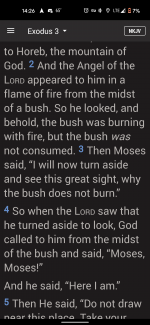
The Bible often refers to God's angelic representatives as YHWH speaking and acting himself as they are acting on his behalf, simply reading Exo 3:2-4 demonstrates this.
Though all the good angels are angels of God, or angels of the Lord, there is one special angel who is distinct and unique from all the other angels, he is
Deut 6:4 was simply reminding the nation of Israel that YHWH was not a God that consisted of many beings or persons, but rather a single deity, "Listen, O Israel: Jehovah our God is one Jehovah".
That's because that wasn't the point of the list. The point of the list was to show that Christ is/was/will always be YHWH, which is CRUCIAL to understanding the tri-unity of God.
Read it again, and consider why such a list might be important:
Christ's message was centered, focused on Himself.
Why is that important? Because NO OTHER CREATURE has the right to focus a message from God upon themselves.
I agree that Jesus is God in some sense according to those verses,
Except that it does. Why? Here's why: If Jesus is not God, then He is a blasphemer, because, as Hebrews 1 rightly states, God spoke through Him, and yet Jesus not only focused His message on Himself, but claimed the words as His own. The ONLY way that Jesus did not place himself above/before God is if He IS God.
NO CREATED BEING EVER has the right to claim ownership of the things of God, nor can a created being rightly focus his message upon himself, saying such things as "Follow me," pray and act "in My name," the Holy Spirit comes "in My name," "I will abide in you," "Do things for My sake," "I never knew you, depart from Me," "love Me," "I am the Way," "I am . . . the Truth," "I am . . . the life," and the list goes on and on.
For ANY created being to utter those things in the same contexts of the verses they are found in, it would be blasphemy.
and there lies the issue. Also, none of those verses express 'God is one being who is three persons who are co-equal and co-eternal',
I'm literally giving you the verses. Are you that blind?
I told you before, just because you can't see it there doesn't mean it's not there, and just because you can't understand it doesn't make it false.
Step back. Try getting the big picture of what I'm trying to tell you for once.
God says "by two or three witnesses a matter is established."
I gave you at least 8 witnesses that God is triune in the post you are responding to.
1) the use of a plural subject with a singular verb in Genesis 1:1
2) The use of "echad" describing the plural "elohim" as "one of unity" in Deuteronomy 6:4
3) Jesus' use of "I say unto you" replacing "thus says the Lord"
4) Jesus' focus on Himself in His ministry, which if He is not God, would be blasphemous
5) John 1 calls the Word (Jesus) "God"
6) Hebrews 1 teaches that the Son is God
7) The Holy Spirit is called God (Acts 5)
8) The Father is, of course, God (1 Thessalonians 1)
And I asked if I should go on, seeing as how 8 should be enough.
Please point out, in Acts 5, 1-5, where Ananias lied to Peter, or said anything, for that matter, that is recorded in scripture.
And if you would also, please, explain why you disagree with Peter when he says that Ananias did NOT lie to men, but to God, and explain why you think Peter was lying when he accused Ananias of lying "to the Holy Spirit."
In addition: Please point out, in my post, where I said anything about Acts 5:9, and how it is relevant to the discussion.
Peter claimed they lied to "not to men, but to God",
But Peter said, “Ananias, why has Satan filled your heart to lie to the Holy Spirit and keep back part of the price of the land for yourself?While it remained, was it not your own? And after it was sold, was it not in your own control? Why have you conceived this thing in your heart? You have not lied to men but to God.” - Acts 5:3-4 http://www.biblegateway.com/passage/?search=Acts5:3-4&version=NKJV
Nope. I would say it's rather explicitly explained by Peter that Ananias, in lying to the Holy Spirit, was lying to God, which makes the Holy Spirit, God.
throughout scripture, there are numerous instances where the following principle is used: Actions by, for or against "A" are logically equivalent to actions by, for or against "B".
For example in 1 Samuel 12:1 it states "Finally Samuel said to all Israel: “Here I have done all that you asked of me, and Iappointed a king to reign over you", however in v13 it states "Look! Jehovah has appointed a king over you". One verse states Samuel appointed a king but the other Jehovah, is Samuel YHWH? No, Samuel appointing a king was equivalent to YHWH appointing a king.
Philippians 3:6 with Acts 9:5
2 Samuel 5:3 with 2 Samuel 12:7
Exo 32:33,35 with Nehemiah 9:11,12
Psalms 77:20 with PSalms 77:20
Numbers 14:2 with Num 14:26,27
Peter was given the gift of HS so he could read and know Ananias was lying according to his heart, Ananias, lied to Peter and the Holy Spirit that God had given to the apostles through Jesus, so was ultimately lying to God.
Peter asked Ananias, "Why have you lied to the Holy Spirit?" He then said, "You have not lied to men, but to God.
By your rationale, Peter is God, because Ananias did not lie to men, as the scripture says, but to God, and you claim that Ananias lied to Peter. Ergo, Peter is God.
But Peter is not God. And Ananias did not, as Peter said, lie to men, but Ananias did, as Peter said, lie to the Holy Spirit.
(John 20:22, 23) "..After saying this he blew on them and said to them: “Receive [the] [H]oly (S)pirit. 23 If you forgive the sins of anyone, they are forgiven; if you retain those of anyone, they are retained...”
1. Does the Bible mention three distinct persons?
No, the bible does not speak of three separate persons, it speaks of the Father and Son and refers to them as persons, but I do not accept the HS as a person.
You cannot lie to something that is not a person. Ananias lied to the Holy Spirit. Ergo, the Holy Spirit is a Person. Whether you accept Him as one has no bearing on that fact.
2. Does the Bible refer to each of these persons as God?
No, it refers to the Father as the 'one God',
No, it does not call others "God(s)." It calls them gods, little 'g'.
Big difference.
See Exo 7:1, 2 Cor 4:4, Ps 8:5, John 10:34 for some examples. Trinitarians first need to explain why people such as Moses are called God ("I have made you GOD to Pharoah" Exo 7:1),
“Behold, I have made you God to Pharaoh, and Aaron your brother shall be your prophet” (Exod. 7:1).
The English versions differ as to the precise translation of the first clause of Exodus 7:1. A few contemporary versions agree with the KJV, which takes it to quote the Lord as saying to Moses, “I have made thee a god to Pharaoh” (so, with slight and irrelevant variations, the KJV, NAB, and NJB). Most contemporary versions take the verse to quote the Lord as telling Moses, “I have made you like/as God to Pharaoh” (so, again with minor variations, the ESV, HCSB, NASB, NET, NIV, NKJV, and NRSV). Several versions offer paraphrases that amount to the same thing: “I have put you in the place of God to Pharaoh” (CJB); “I have set thee in God’s stead to Pharaoh” (JPS 1917); “I place you in the role of God to Pharaoh” (TNK); and “I will make you seem like God to Pharaoh” (NLT). The majority of versions is not always right, but in this instance exegesis of the text shows they are quite correct.
The Hebrew says, “I have made you elohim to Pharaoh.” Notice that the Lord (Yahweh) did not tell Moses that he “is” elohim but that the Lord has “made” Moses elohim “to Pharaoh.” These qualifications make it absolutely clear that this text is to be understood along the same lines as Exodus 4:16, which as we have seen in the Hebrew is a simile. In this text the lack of the particle meaning as simply changes the figure of speech from a simile to a metaphor. A metaphor is a figure of speech in which a comparison is made without the use of the words as or like. In other respects, though, a metaphor is equivalent to a simile in terms of the resulting meaning. Thus the sentences, “My daughter is like an angel” and “My daughter is an angel” mean exactly the same thing. Anyone reading the first sentence and then shortly thereafter reading the second sentence ought to have no trouble understanding that the second sentence is a metaphor.
The Septuagint translates the same clause, “I have given you [as] God to Pharaoh” [dedōka se theon Pharaō]. Here se theon is a double accusative, object-complement construction, in which se (“you”) is the direct object of the verb and theon (“God”) is the complement. The construction can be used to express a metaphor, as in Jesus’ statement that he had come “to give [dounai, the infinitival form of the same word didōmi used in Exodus 7:1 LXX] his life [as] a ransom [tēn psuchēn autou lutron] for many” (Mark 10:45). Here “ransom” is a metaphor that expresses the significance of Jesus giving his life (i.e., dying) for the many thereby benefited. Thus, the LXX rendering of Exodus 7:1 is also easily interpreted as referring to Moses as “God” metaphorically. In light of Exodus 4:16, that is exactly how we should take it.3 This means that we should translate elohim and theos in Exodus 7:1 “[as] God” rather than “a god.”
Even if one were to prefer the rendering “a god” in Exodus 7:1, in context the statement would still be metaphorical. That is, if that were the correct translation, then the text would mean that the Lord said that he would make Moses like a god to Pharaoh.
prior to them assuming Jesus being called GOD implies he is [JR: Again, I presume you meant to say "not"] the 'one God', since 1 Cor 8:6, among other scripture, clearly teaches the Father is the 'one God'.
In other words, yes, the Bible teaches there is only one God. Period.
I'm using "G" for a reason, NWL. First, it's His name, and second, using it as a rule of thumb helps distinguish between God and gods.
however, it clearly teaches there are other beings that are correctly called G-god, the term "G-god" when applied to these ones only relates to them in a secondary lesser sense; simple read 1 Cor 8:4-6 to see this.
In other words, yes, the Bible teaches there is only one God, big 'G,' which is what I asked.
“there is no God but one.” For although there may be so-called gods in heaven or on earth—as indeed there are many “gods” and many “lords”— 6 yet for usthere is one God, the Father" (1 Cor 8:4-6)
For even if there are so-called gods, whether in heaven or on earth (as there are many gods and many lords),yet for us there is one God,the Father, of whom are all things, and we for Him; and one LordJesus Christ, through whom are all things, and through whom we live. - 1 Corinthians 8:5-6 http://www.biblegateway.com/passage/?search=1Corinthians8:5-6&version=NKJV
Last I checked, God is through whom are all things, and through whom we live. That makes Jesus God.