@Clete One of your posts in another thread where you mentioned "a properly functioning clock" made me curious about clocks and time...
All clocks measure some sort of physical phenomenon, such things as (not an exhaustive list):
Atomic vibrations
Gravitational affects
Pendulums
Sandglass/Hourglass
Planetary Motion
Rotations (days)
Orbits (years)
But none of those things are grounded purely in time itself. So what would you consider to be a properly functioning clock? Is there such a thing as "absolute time" and if so, how would that be measured/tracked?
Also, all of those clocks have some sort of drift from the thing that they use as their reference. And, all of those references are somewhat different.
A clock is any set of successive events used to measure other events. The ticks of a clock are the functional equivalent of the marks on a ruler. They can be virtually anything. They don't even have to be particularly regular, depending on what it is you're interested in measuring.
People have used all sorts of things as rulers throughout history. We've measured distances in handbreadths, finger widths, forearm lengths, footsteps, horse lengths and even city blocks. A carpenter might use a piece of scrap wood to measure the spacing between studs. A farmer might measure the size of a field by seeing how much of it can be plowed in a day.
The same is true of clocks. We can measure time by counting heartbeats, the swings of a pendulum, the oscillations of a quartz crystal, the dripping of water, the burning of a candle, the rotations of the Earth or the cycles of radiation associated with an atomic transition.
If I wanted to know how long someone could hold his breath, I could measure it in heartbeats. If I wanted to know how long a tree had been growing, I could count its growth rings. If I wanted to express the length of time between two historical events, I could measure it in human generations. The usefulness of any particular unit of measurement depends on the nature of what is being measured and the degree of precision required.
The point being that all measurement is fundamentally an act of comparison. When we measure the length of something, we are comparing its length to the length of something else. When we measure the duration of an event, we are comparing its duration to the duration of some other event or sequence of events.
Both space and time are abstractions. We abstract the concept of space from the spatial relationships of objects, and we abstract the concept of time from the temporal relationships of events. The relationships themselves are quite real, of course, which is precisely why we can measure them. A ruler is a physical object whose spatial properties we use as a standard against which to measure the spatial properties of other physical objects. A clock is a physical process whose temporal properties we use as a standard against which to measure the temporal properties of other processes and events.
What else could either possibly be? What would it mean to ground a unit of temporal measurement in "time itself"? How would that be any more possible than grounding a unit of spatial measurement in "space itself"? There is no way to establish a physical unit of measurement independently of the concrete realities from which the concept being quantified is abstracted.
Even the most sophisticated atomic clock ever devised operates on the same fundamental principle as a man counting his own heartbeats. Thus, a properly functioning clock is one that reliably produces the events that constitute its intended standard of temporal measurement.
As for whether absolute time exists, I'm not entirely sure the question makes sense. I could just as easily ask whether absolute space exists.
Suppose two trees are standing fifty feet apart. Is their separation an objective fact? Certainly. Does that require distance to exist independently of the trees? Of course not. Distance describes a relationship between the trees. Similarly, we can acknowledge the temporal separation of two events as an objective fact without supposing that time exists independently of those events. The objectivity of a relationship does not require the independent existence of the abstraction by which we describe that relationship.
Further, how would we go about establishing a standard of temporal measurement as absolute? We would have to compare it to something else, which would then become the standard by which we measure our standard. We could then ask by what standard that standard is established as absolute. The question can be repeated indefinitely because no number of comparisons can establish independence from comparison.
Likewise, to suggest that time exists independently invites the question, "Independent of what?" Independent of the very events whose relationships we abstract to arrive at the concept of time in the first place? If we are speaking of something that exists independently of events, then we've abandoned the concept of time as we've understood it thus far and are now using the word to refer to something else entirely.
Thus, it seems to me, that the phrase "absolute time," is a tacit attempt to retain a relational concept while stripping it of the very relationships that give it meaning.
P.S. I've thought of something related to the issue of absolute time that I think will add substantively to this post. I have to think it through for a while. It'll be almost certainly turn into a whole essay of it's own.
When God first created, He first made the things that could show time before He talked about the passage of time.
Gen 1:4 - And God saw the light, that it was good; and God divided the light from the darkness. Gen 1:5 - God called the light Day, and the darkness He called Night. So the evening and the morning were the first day.
Morning and evening became possible because light was separated from darkness and there was a progression between the two. We really don't know how long this took except that the progression was there at the end. Note that though day and night are mentioned, years are not, because,
as far as we can
tell, years require a sun that wasn't formed yet.
Gen 1:14 - Then God said, “Let there be lights in the firmament of the heavens to divide the day from the night; and let them be for signs and seasons, and for days and years.
With the sun, moon, and stars, years and seasons can be distinguished.
It seems possible to me that the first days could have been much longer or shorter than our current days, though the plants on day 3 would limit the variation to what they could handle in the conditions before the sun existed.
It is interesting that the standard God established for measuring time is a good one for what time is, and we have to adjust our cesium clocks every now and then (leap seconds) to match days and years.
@Clete Thanks a lot. I'm not even sure that I thought that I meant by "absolute time", but I can see that I might have been misthinking that one.
So, is it true then that the only way to know if a clock is not working properly is to compare it to other comparable clocks that are working properly?
When God first created, He first made the things that could show time before He talked about the passage of time.
Gen 1:4 - And God saw the light, that it was good; and God divided the light from the darkness. Gen 1:5 - God called the light Day, and the darkness He called Night. So the evening and the morning were the first day.
Morning and evening became possible because light was separated from darkness and there was a progression between the two. We really don't know how long this took except that the progression was there at the end. Note that though day and night are mentioned, years are not, because,
as far as we can
tell, years require a sun that wasn't formed yet.
Gen 1:14 - Then God said, “Let there be lights in the firmament of the heavens to divide the day from the night; and let them be for signs and seasons, and for days and years.
With the sun, moon, and stars, years and seasons can be distinguished.
It seems possible to me that the first days could have been much longer or shorter than our current days, though the plants on day 3 would limit the variation to what they could handle in the conditions before the sun existed.
The earth changed dramatically during the events associated with the flood. Days became much shorter (earth lost mass and contracted in diameter), for example, from 360 days in a year to ~365.24. The moon was also impacted (literally) by those same events causing the lunar month to change 30 days to ~29.5.
It is interesting that the standard God established for measuring time is a good one for what time is, and we have to adjust our cesium clocks every now and then (leap seconds) to match days and years.
We don't actually adjust a cesium clock. We compare what it measures to the orbit and spin of our planet and adjust our "wall clocks" according to those observations.
Before the flood, it was much more straightforward to measure the days/years/seasons (12-30 day months for a 360 day year).
Which are an invention of man to measure small time intervals that are fractions of larger time intervals, despite attempts to wrest one from the other.
The earth changed dramatically during the events associated with the flood. Days became much shorter (earth lost mass and contracted in diameter), for example, from 360 days in a year to ~365.24. The moon was also impacted (literally) by those same events causing the lunar month to change 30 days to ~29.5.
We don't actually adjust a cesium clock. We compare what it measures to the orbit and spin of our planet and adjust our "wall clocks" according to those observations.
You are correct in one sense. A cesium "clock" is not really a clock, but a stable frequency source--one of those physical phenomena that you mentioned above. For it to become an actual clock, it needs something that accumulates numbers of lapsed cycles of the frequency. These are what are adjusted to add or subtract leap seconds.
Yes, I agree. So you would also agree, I hope, that during creation week the things that measure days and years and seasons are necessary before days and years (maybe seasons, too) can be accurately counted. Thus light and darkness were needed before a day could be counted. We know that God was not idle before creation, as @Clete pointed out, but how long He took to do tasks before the time system He inaugurated was available is in question. And how long days and years might have been immediately after He inaugurated said system is a matter of conjecture. Thus, when we are told in Exodus 20 that God made everything in 6 days, we can't really make the jump to say it took 6x86400 seconds the way we define seconds today. Or 6x24 hours using hours defined as 3600 times what we currently define as a second.
Because creation started in darkness and moved to light ("evening and morning were the first day") and light was made in that first day, and because the relative motion of the earth and sun have changed enough that it was measurable due to the flood, we can't be sure that the first day or two or six were exactly the same as days today, or even that they were exactly the same as each other.
Morning and evening became possible because light was separated from darkness and there was a progression between the two. We really don't know how long this took except that the progression was there at the end.
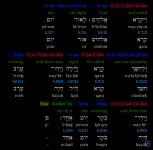
This is where having access to an interlinear would help, along with a basic understanding of how the ancients perceived the world, because we know, based on the Hebrew text, exactly how long it was: one ordinary day.
"[And there was] [evening (Noun, masculine SINGULAR)] [and there was] [morning (Noun, masculine SINGULAR)], [day (Noun, masculine SINGULAR)] [the first]."
While the interlinear renders "echad" as "the first," the Hebrew literally reads "one day."
The people this was written for knew what a day was. They understood light and dark. They knew what evening and morning were. Thus, they would have understood that these first few verses all occurred within what they knew as one day.
To your point, Moses establishes the unit of measurement and then proceeds to enumerate the subsequent days using that same unit of measurement.
The only way you get a substantially longer period of time than an ordinary day is by imposing it on the text, because there is nothing within the immediate context to indicate that anything other than an ordinary day was meant.
Nor does the context of the next few verses give any indication that the "second day" was anything different in meaning from the first, as it ends just like the first, with evening and morning.
In Exodus 16:13, you have something happening in the evening, followed by a morning phenomenon.
In Exodus 18:13, you have "on the next day," and "from morning until evening."
Morning to evening is day. Evening to morning is called night. Together, they constitute one complete daily cycle.
We know that the rotation of the earth is what ordinarily accounts for this cycle.
Now consider what God says in Exodus 20:
“Remember the Sabbath day, to keep it holy. Six days you shall labor and do all your work, but the seventh day is the Sabbath of the LORD your God. In it you shall do no work: you, nor your son, nor your daughter, nor your male servant, nor your female servant, nor your cattle, nor your stranger who is within your gates. For in six days the LORD made the heavens and the earth, the sea, and all that is in them, and rested the seventh day. Therefore the LORD blessed the Sabbath day and hallowed it. https://www.biblegateway.com/passage/?search=Exodus 20:8-11&version=NKJV
God explicitly bases man's seven-day week upon His own creation week. The very same unit of measurement is employed for both, without qualification.
How, then, would the ancient Hebrews have understood the length of the first day of creation, given that God explicitly included it among the seven days upon which their ordinary seven-day week was based?
And how long days and years might have been immediately after He inaugurated said system is a matter of conjecture. Thus, when we are told in Exodus 20 that God made everything in 6 days, we can't really make the jump to say it took 6x86400 seconds the way we define seconds today. Or 6x24 hours using hours defined as 3600 times what we currently define as a second.
Because creation started in darkness and moved to light ("evening and morning were the first day") and light was made in that first day, and because the relative motion of the earth and sun have changed enough that it was measurable due to the flood, we can't be sure that the first day or two or six were exactly the same as days today, or even that they were exactly the same as each other.
I won't argue that the first day lasted precisely 86,400 seconds as we define seconds today. However, the text establishes that it was an ordinary day, comparable in duration to the other days of creation.
Interestingly enough, your observation that creation began in darkness and progressed to light actually reinforces my point.
Consider the sequence of events:
God creates the heavens and the earth, presumably setting the earth in rotation.
Darkness covers the face of the deep.
God creates light.
God separates the light from the darkness, presumably establishing directional illumination of the earth.
God calls the light Day and the darkness Night.
Evening and morning occur, marking the completion of the first day.
Notice the progression. We already have darkness preceding the creation of light. We then have light, followed by a return to darkness (evening), followed by a return to light (morning). All of this is encompassed within what Moses calls "one day."
Presumably, God set the earth in rotation at or shortly after its creation, and the subsequent separation of light from darkness established the alternating periods of daylight and nighttime by which that rotation could be measured.
In other words, the establishment of the means by which a period of time is measured does not necessarily mark the beginning of the period being measured.
And given that God explicitly includes the creation of the heavens and the earth in the six days upon which He bases man's ordinary working week, what reason do we have, exegetically speaking, to suppose that the first day was substantially different in duration from the subsequent days?
Is it conceivable that God caused the earth to rotate substantially more slowly during the first day?
Sure.
But where does Scripture give us any indication that He did?
Even though I agree that the Flood altered the duration of a day, that tells us nothing about whether the days of creation differed substantially in duration from one another.
That something is conceivable does not make it exegetically warranted.
Spoiler
This reminds me of something Bob Enyart started teaching, as I remember it, in conjunction with his adoption of the HPT -- and it coincides with the point you made, @Clete, in your thread about truth, that truth converges -- that just because we can conceive of miracles that would allow for theories such as the canopy theory or catastrophic plate tectonics doesn't mean that we are exegetically justified in invoking those miracles to accommodate those theories. God's ability to perform a miracle does not constitute evidence that He performed it. Unless the text describes or otherwise gives us reason to infer that a particular miracle occurred, we should avoid introducing one simply to make a theory work.
The text gives us positive reason to understand the six days of creation as ordinary days of comparable duration, particularly in light of Exodus 20. It gives us no corresponding reason to suppose otherwise.
Such a possibility arises from speculation about the text, not exegesis of it.