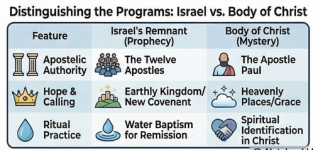
Alright, your AI experiment is a perfect opportunity that should allow us to land this plane.I had Gemini read "The Plot" (2013 edition) and I asked it this question: "Is there water baptism in Romans 6"?
Here's what it said:
According to the provided text, Romans 6 refers to spiritual baptism, not water baptism. The text makes the following points regarding baptism in Romans 6:
- Baptism into Christ's Death: Romans 6:3-4 describes believers being "baptized into Christ" and "buried with Him through baptism into death". The author interprets this as the mechanism by which each believer "dies to the law through the death of Christ" individually.
- Identification with the Body: The text links the baptism in Romans 6 to the baptism by the Spirit into the Body of Christ described in 1 Corinthians 12:13 ("For by one Spirit we were all baptized into one body").
- Contrast with Water Baptism: While the Bible presents "various baptisms" (washings) that were symbolic, the author identifies the "baptism by the Spirit into the Body" as the one "most importantly, for Christians today".
- Effect of this Baptism: Through this spiritual baptism, sinners are "delivered from the law". The author argues that this deliverance occurs "only when they die to it... as they are baptized into the Body of Christ (Rom. 6:3-4)".
I think at this point it should be pretty clear why debates about water baptism never actually get resolved. The problem isn’t that the verses are unclear, and it isn’t that one side is being dishonest. The problem is that the disagreement isn’t really about baptism at all. It’s about the framework being used to interpret the text.
If you start with a sacramental or covenantal paradigm, you are going to see water baptism in passages like Romans 6. If you start with a Mid-Acts framework, you are not. Both sides can point to the same verses, make arguments that sound perfectly reasonable, and accuse the other of question begging. In a sense, both are right to do so, because both are reasoning from prior commitments that the other side does not share.
That’s why appealing to something like The Plot, or even feeding it into an AI and asking for an answer, doesn’t actually prove anything. All that demonstrates is that if you assume a Mid-Acts framework, you will get a Mid-Acts answer. You don’t need AI for that. Anyone who accepts that paradigm will arrive at the same conclusion. The answer is coming from the system, not from the text considered in isolation.
As I've said a few times already. I’m not arguing against the doctrine itself, except by proxy. I personally agree that Romans 6 is speaking about our identification with Christ in His death, burial, and resurrection, and that this is a spiritual reality, not something water can accomplish. What I am pushing back on is the idea that this reading is so obvious that any other view is automatically wrong. It isn’t. The text is capable of being read differently, and the fact that it consistently is, by serious and competent readers, proves that the issue does not find it's center of gravity in the text itself.
This is why trying to debate water baptism directly is a mistake. You can’t win that debate in any meaningful sense, because you are arguing about a conclusion while leaving the premises untouched. As long as two people are operating from different paradigms, they will continue to read the same passages differently, and no amount of back-and-forth over individual verses is going to resolve that.
If someone actually wants to settle the issue, the discussion has to move upstream. It has to deal with the framework itself. How should Scripture be divided? What is the relationship between the ministries of Peter and Paul? What defines the Body of Christ? How does progressive revelation function? Those are the questions that determine how passages like Romans 6 are understood.
Until those questions are addressed, debates about water baptism will continue to go in circles. Not because the participants are careless or irrational, but because they are starting from different first principles. If those first principles go undefined and unstated then they are going to look exactly like question begging because without that underlying framework, that's what they are.
So the real issue is not whether Romans 6 “includes” or “excludes” water baptism. The real issue is which framework best accounts for the totality of Scripture. Until that is established, you’re not actually debating baptism. You’re just watching two different systems produce two different answers from the same text. You simply cannot establish either position with proof-texts. It doesn't work because the texts change meaning based on the paradigm that is in place when those texts are read.
This is what makes The Plot such an incredibly important and profound work of theology. It addresses first principles and over arching principles and then lets the details fall into place within that framework. In my view, all theological debates should be predicated on paradigm level premises. Everything else is mostly a waste of energy.

 You sure sounded like you cannot agree that Romans 6 is dry, in previous posts.