The myth of the "early church"

JudgeRightly

裁判官が正しく判断する
Staff member
Administrator
Super Moderator
Gold Subscriber
Understood, but I've grown increasing tired of Derf's anti-Pauline, anti-God views. He makes a mockery of God's Word.

I get what you're trying to say, but even after all these years of being on here, I'm still learning things. It's incredibly distracting when of the two members whom I'm trying to understand the argument between, the one whom I disagree with on the matter is being polite and resectful (if a bit stubborn (sorry @Derf!)), and the other whom I agree with is being what most people would consider extremely rude.

We can share the truth in love, and yes, being nice isn't always necessary, but I don't think that the crass language is necessary, even for Derf, who I generally consider not my enemy in theological matters.
 

VladtheDestroyer

Well-known member
Rev 22:16 I Jesus have sent mine angel to testify unto you these things in the churches. I am the root and the offspring of David, and the bright and morning star.

I would be curious to know how @Derf or any of you view this verse, as it always seemed to me that Jesus was addressing 2 groups here,

"The root of David" would have no significance to gentiles at during the time of Christ.

Likewise "the bright and morning star" would have had no significance to the Jews of that time. However the first people to honor Christ as King were thought to be gentile astronomers. Morning times were actually more significant in ancient astronomy then evening times, particularly daybreak.
 

Derf

Well-known member
Rev 22:16 I Jesus have sent mine angel to testify unto you these things in the churches. I am the root and the offspring of David, and the bright and morning star.

I would be curious to know how @Derf or any of you view this verse, as it always seemed to me that Jesus was addressing 2 groups here,

"The root of David" would have no significance to gentiles at during the time of Christ.

Likewise "the bright and morning star" would have had no significance to the Jews of that time. However the first people to honor Christ as King were thought to be gentile astronomers. Morning times were actually more significant in ancient astronomy then evening times, particularly daybreak.
I read 1 commentary that mentioned the idea that the morning star heralded the coming of the daylight sun, so it made me think of the Rev reference as about the resurrection, with Christ as the first fruits.
 
Last edited:

Derf

Well-known member
They are NOT "universal" as they are part of TWO DIFFERENT (and conflicting) dispensations of God
The point of the term "universal" is to differentiate between separate church congregations (yes, I know that's kind of like "tuna fish") and the sum total of all parts of Christ's body on the one hand or groups of believing Jews (synagogues?) vs all of the members of the church of Israel. Since you say they are different dispensations, I think you have answered my question in the affirmative: that there are two universal churches in your system, one of Israel and one of the BOC.
 

Derf

Well-known member
We have access to God without going through Israel.
I don't disagree with what you have said, but how is that an answer to my post? I don't see how that answers the question about who the two peoples are that once were separated by the law and now have become one group. These can't be believers in the Jew and Gentile camps, because it is apparent from the previous verses that the Gentiles did not have "believers", since they did not have access to God, as you intimated.
 

Right Divider

Body part
The point of the term "universal" is to differentiate between separate church congregations (yes, I know that's kind of like "tuna fish") and the sum total of all parts of Christ's body on the one hand or groups of believing Jews (synagogues?) vs all of the members of the church of Israel. Since you say they are different dispensations, I think you have answered my question in the affirmative: that there are two universal churches in your system, one of Israel and one of the BOC.
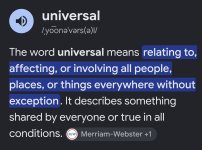
I'm afraid that you don't know what "universal" means.
AISelect_20260812_220544_Google.jpg
 

Derf

Well-known member
I'm afraid that you don't know what "universal" means.
View attachment 16041
Do you test your AI answers, or do you accept them indiscriminately?

Here's Merriam Webster's first definition:

1. including or covering all or a whole collectively or distributively without limit or exception
especially : available equitably to all members of a society
Eg. universal health coverage

Note that universal health coverage might apply to members of one society without necessarily applying to all members of all societies.
 

Derf

Well-known member
Back to this...
Complete and utter baloney.

Israel was FALLEN... why would anyone want to be joined to that?
This was a question I had posed in other threads, though in different words, so I'm glad we're in agreement. Since the kingdom of Israel is not in any way desirable, why would Paul agree to go only to the uncircumcised while allowing the twelve to continue going to a fallen kingdom with a gospel of that kingdom that would do nobody any good?
.


You seriously could not be more full of crap.
I'm sure you are mistaken.
Eph 2:11-22 (AKJV/PCE)​
(2:11) Wherefore remember, that ye [being] in time past Gentiles in the flesh, who are called Uncircumcision by that which is called the Circumcision in the flesh made by hands; (2:12) That at that time ye were without Christ, being aliens from the commonwealth of Israel, and strangers from the covenants of promise, having no hope, and without God in the world: (2:13) But now in Christ Jesus ye who sometimes were far off are made nigh by the blood of Christ. (2:14) For he is our peace, who hath made both one, and hath broken down the middle wall of partition [between us]; (2:15) Having abolished in his flesh the enmity, [even] the law of commandments [contained] in ordinances; for to make in himself of twain one new man, [so] making peace; (2:16) And that he might reconcile both unto God in one body by the cross, having slain the enmity thereby: (2:17) And came and preached peace to you which were afar off, and to them that were nigh. (2:18) For through him we both have access by one Spirit unto the Father. (2:19) Now therefore ye are no more strangers and foreigners, but fellowcitizens with the saints, and of the household of God; (2:20) And are built upon the foundation of the apostles and prophets, Jesus Christ himself being the chief corner [stone]; (2:21) In whom all the building fitly framed together groweth unto an holy temple in the Lord: (2:22) In whom ye also are builded together for an habitation of God through the Spirit.

We are "made nigh by the BLOOD"... not by becoming some part of Israel.

Made nigh to what? Remember the passage is about what the Gentiles were previously separated from, and that was described as the commonwealth of Israel AND Christ:
"That at that time ye were without Christ, being aliens from the commonwealth of Israel, and strangers from the covenants of promise, having no hope, and without God in the world:"
And remember that the answer seems to have been to be "in Christ," so that they, working backwards in that verse, would no longer be 1. without God, 2. having no hope, 3. strangers from the covenants of promise, and 4. aliens from the commonwealth of Israel.
That last one is what we seem to be at odds about. Are you saying that the commonwealth of Israel is different from that fallen kingdom of Israel? If so, what is the difference? If not, how can they be no longer aliens from the commonwealth of Israel and not somehow be part of Israel?

!

Fellowcitizens of the household of God and NOT in the "commonwealth of FALLEN Israel"
But the commonwealth of fallen Israel, as you say, had God, hope, and covenants of promise, so it seemed to be desirable. AND the Twelve were still preaching its gospel, according to your theology. Why were they still preaching a useless, undesirable "gospel"?
 

Right Divider

Body part
This was a question I had posed in other threads, though in different words, so I'm glad we're in agreement. Since the kingdom of Israel is not in any way desirable, why would Paul agree to go only to the uncircumcised while allowing the twelve to continue going to a fallen kingdom with a gospel of that kingdom that would do nobody any good?
The kingdom of Israel was quite desirable, because God promised it to Israel.

The twelve were given a mission to Israel, Paul was given a mission to all people regardless of the ancestry.
Made nigh to what?
God.
Remember the passage is about what the Gentiles were previously separated from, and that was described as the commonwealth of Israel AND Christ:
"That at that time ye were without Christ, being aliens from the commonwealth of Israel, and strangers from the covenants of promise, having no hope, and without God in the world:"
Without God; that is the summation of what Paul is saying.
Now they are made nigh to God... it's really pretty simple if you don't have blinders on.
 

Right Divider

Body part
Do you test your AI answers, or do you accept them indiscriminately?

Here's v first definition:

1. including or covering all or a whole collectively or distributively without limit or exception
especially : available equitably to all members of a society
Eg. universal health coverage

Note that universal health coverage might apply to members of one society without necessarily applying to all members of all societies.
There is no difference between that definition and the one that I quoted.

The body of Christ is not Israel and Israel is not the body of Christ.

P.S. Do you just accept Merriam Webster's indiscriminately? :unsure:
 

Nick M

Fully Semi-Automatic
LIFETIME MEMBER
Hall of Fame
I don't disagree with what you have said, but how is that an answer to my post?
It directly addresses your point about the middle wall. That refers to us having no hope in the world. Only Israel was with God.
 
Top