Right Divider
Body part
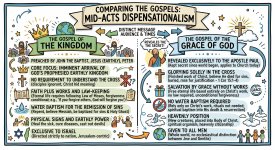
According to the Mid-Acts dispensationalist perspective, the gospel of the kingdom and the gospel of the grace of God are two distinct salvation messages given by God to different audiences at different times.
The Gospel of the Kingdom This message was preached by John the Baptist, Jesus during His earthly ministry, and Peter in the early chapters of Acts. Its core focus was the imminent arrival of God's prophesied, literal earthly kingdom with Jesus as the Messiah and King.
Key characteristics of the gospel of the kingdom include:
Key characteristics of the gospel of the grace of God include:
The Gospel of the Kingdom This message was preached by John the Baptist, Jesus during His earthly ministry, and Peter in the early chapters of Acts. Its core focus was the imminent arrival of God's prophesied, literal earthly kingdom with Jesus as the Messiah and King.
Key characteristics of the gospel of the kingdom include:
- No requirement to understand the cross: The twelve disciples actively preached the gospel of the kingdom in towns and villages, yet Jesus explicitly had to hide the meaning of His impending death and resurrection from them. Because they were entirely ignorant of the cross, Christ's atoning sacrifice was not the mechanism of salvation in this message.
- Faith plus works and law-keeping: To inherit eternal life under this gospel, individuals were instructed to follow the law of Moses. Furthermore, forgiveness was strictly conditional; for example, Jesus taught that God would only forgive people if they first forgave others.
- Water baptism for the remission of sins: Entering this kingdom required an individual to repent, believe Jesus was the Messiah, and be water baptized to receive the remission of sins and the Holy Ghost.
- Physical signs and earthly dominion: The preaching of this gospel was accompanied by physical, visible power, such as healing the sick, curing diseases, and casting out devils.
- Exclusive to Israel: This gospel was directed strictly to the nation of Israel and tied geographically to Jerusalem, as prophecy dictated the kingdom must be established in Zion first before any blessings could flow to the Gentiles.
Key characteristics of the gospel of the grace of God include:
- Glorying solely in the cross: The entire foundation of this gospel is the finished work of Christ. It explicitly requires believing that Christ died for your sins, was buried, and rose from the dead for your justification (1 Corinthians 15:1-4).
- Salvation by grace without works: Eternal life is given freely based entirely on what Christ did, with absolutely no requirement to keep the law or perform works. Forgiveness is offered unconditionally for Christ's sake, rather than being conditional upon human actions.
- No water baptism required: Because salvation relies entirely on Christ's finished work, physical rituals like water baptism are not required for salvation, identity in Christ, or church membership. Instead, believers are spiritually baptized into Christ's death and resurrection.
- Heavenly position: Rather than an earthly kingdom in the flesh, believers of the gospel of grace are made "new creatures" and placed into a spiritual organism—the body of Christ—which holds a heavenly position and citizenship.
- Given to all men: This gospel is preached to the whole world, without any ecclesiastical distinction between Jew and Gentile.